


Waste and spent nuclear fuel from nuclear facilities and power plants in several countries, including Sweden, are planned to be disposed of in granitic bedrock in specialized repositories. Repositories planned to be constructed at high latitudes are particularly likely to be affected by future ice ages, with significant hydraulic and hydrogeochemical effects from massive glaciers spreading across the landscape. One potential effect is the infiltration of oxygen-rich glacial meltwater deep into the groundwater system, driven by the high hydraulic gradients that can develop at the glacier’s edge. A thorough understanding and description of the bedrock’s buffering capacity are therefore essential to assess how redox conditions at repository depth might be affected and how this could, for example, induce corrosion of the fuel encapsulation and increase the mobility of released radionuclides within rock fractures.
Kemakta has played a central role for many years in the development and evaluation of oxygen intrusion models. In preparation for the latest safety analysis for SKB’s spent fuel repository, Kemakta led the work on developing baseline models and reporting on the oxygen intrusion modelling (Sidborn et al. 2010).
Work continues to refine the models and further substantiate the parameterization of the models. A scientific article has been published with a particular focus on the role of heterogeneity in the matrix’s micropore network and mineralogy, and how this can affect the depth of oxygen intrusion (Trinchero and Sidborn et al. 2019). For this purpose, a numerical model was used in which the rock matrix’s microporosity is represented by a network of discrete pores that transport dissolved O2 to mineral surfaces, where reactions occur and the oxygen is abiotically consumed.
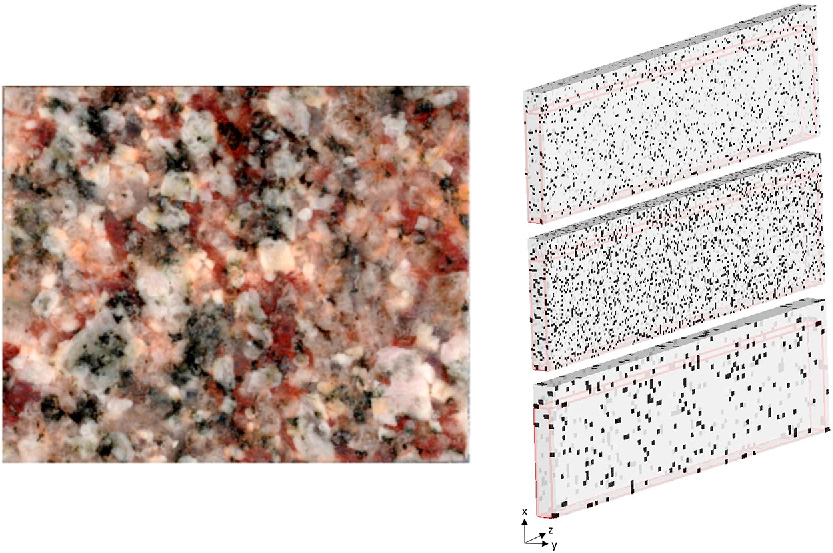
Photograph of intact Ävrö granodiorite from Oskarshamn showing biotite (black grains) along with quartz and feldspar (grey, white, and pink grains). To the right, a model representation is shown with three different biotite grain distributions (black grains).

Concentration profile of oxygen in the matrix micropores for four different modelling cases at steady-state.
References
Sidborn M, Sandström B, Tullborg E-L, Salas J, Maia F, Delos A, Molinero J, Hallbeck L, Pedersen K, 2010. ”SR-Site: Oxygen Ingress in the Rock at Forsmark during a Glacial Cycle”, SKB TR-10-57, Svensk Kärnbränslehantering AB.
Trinchero P, Sidborn M, Puigdomenech I, Svensson U, Ebrahimi H, Molinero J, Gylling B, Bosbach D, Deissmann G, 2019. “Transport of Oxygen into Granitic Rocks: Role of Physical and Mineralogical Heterogeneity”, Journal of Contaminant Hydrology 220: 108–18.
