The age of groundwater is a measure of water turnover and is used to assess the sensitivity of aquifers for drinking water production, to investigate the mixing processes of saline water, or to evaluate the suitability of rock for a deep geological repository for spent nuclear fuel. Existing techniques for dating/age determination of groundwater can be broadly categorized into two types: methods based on chemical processes and methods based on physical principles.
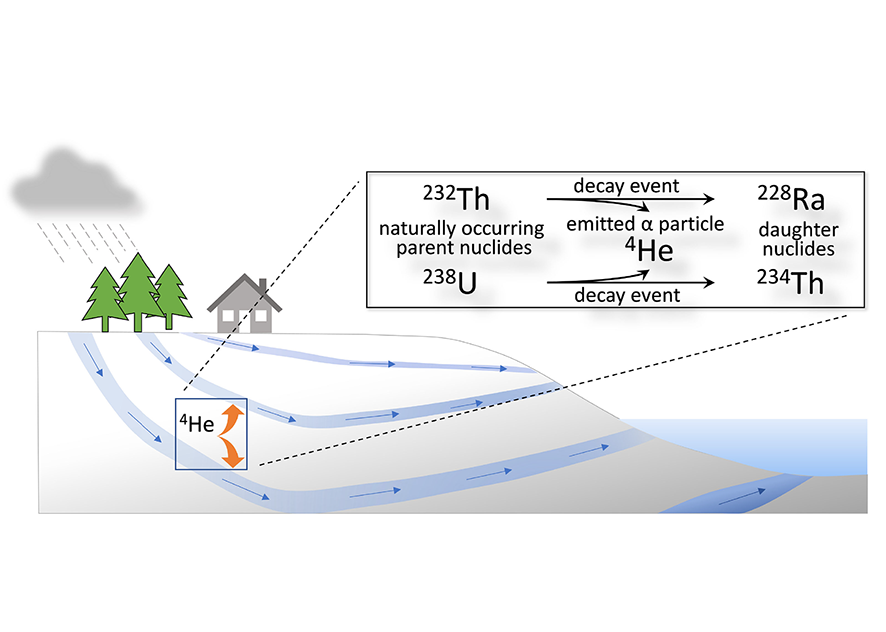
Kemakta, as part of a project team, has developed a method to estimate groundwater residence time from measured helium concentrations. The concept is based on the knowledge that helium is continuously produced through α-decay of naturally occurring uranium and thorium in the bedrock. Helium, being an inert gas, dissolves in the pore water of the rock matrix and is transported with the groundwater, accumulating along flowing fractures in the rock without being broken down. Therefore, measured helium concentrations can be used as an indicator of the residence time of groundwater in the flowing fractures in the rock.
Advantages of the method include:
- It provides a direct estimate of groundwater age/residence time without involving numerical calculations.
- Existing helium measurement techniques can be used.
- It can be employed for evaluating large-scale solute transport and water turnover in fractured rock.
The method has been tested on a site scale for a generic area of 1024×1024×128 meters and on a regional scale for an area of 12×12×2 km in Forsmark, Sweden. It has shown good agreement when compared to an established physical method (Goode 1996) for medium residence times (see figure).
Work continues to refine the method, with some aspects having been published in a scientific article in Journal of Hydrology
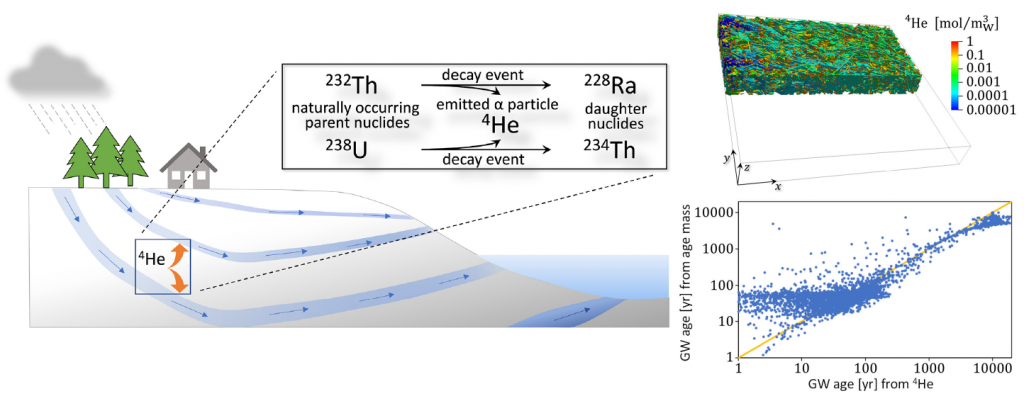
Left: Accumulation of naturally produced helium from α-decay along flow paths in fractured rock.
Upper Right: Groundwater age calculated from the concentration of 4He.
Lower Right: Calculated age (in a cross-section of the model at y=512 m) versus age calculated from the “groundwater age mass” concept. (Goode 1996).
References
Goode D J, 1996. Direct simulation of groundwater age. Water Resources Research 32, 289-296.
Trinchero P, Sidborn M, Puigdomenech I, Iraola A, Bosbach D, Deissmann G, 2019.
Groundwater age dating in fractured rock using 4 He data, Journal of Hydrology X
doi: https://doi.org/ 10.1016/j.hydroa.2019.100036