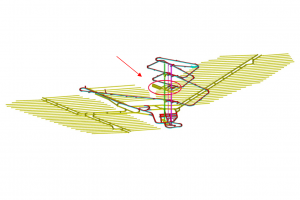
Posiva is planning to establish a potential repository for low- and intermediate-level waste (LILW-R) from the operation and decommissioning of the encapsulation plant for spent nuclear fuel. The facility is planned to be located at a depth of approximately 180 meters below ground, above the repository for spent nuclear fuel (SNF-R) at Olkiluoto, Finland.
Kemakta was commissioned to identify, quantify, and evaluate the potential chemical impact of LILW-R on the SNF-R repository using reactive transport modelling, among other tools. With modelling tools that couple chemistry and transport, the evolution of water chemistry in LILW-R was characterized as a result of concrete leaching and cellulose degradation over very long timescales (approximately 100,000 years). Based on this, the chemical composition of the leachate plume from LILW-R, including elevated alkalinity, was characterized. Through calculations of dilution processes and chemical buffering reactions, it was shown that the impact of the alkaline plume from LILW-R on the safety-critical functions of SNF-R was negligible.
The study also considered the migration of high-density fluids due to the dilution of salts from the waste and the formation of hydrogen gas through the corrosion of steel in the waste and the reinforced concrete structure. These factors were found to have no impact on SNF-R. Additionally, the study identified that the concrete could be weakened if different types of concrete are used in the base slab and the reinforced concrete structure due to chemical reactions.