SKB plans to dispose of decommissioned nuclear reactor tanks in the final repository for short-lived and intermediate-level waste, SFR. The tanks are made of carbon steel with induced radioactivity, and the release from these tanks is largely governed by the corrosion rate.
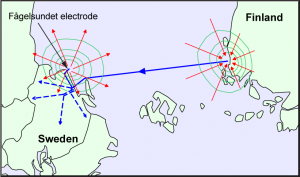
A high-voltage direct current (HVDC) line through the Baltic Sea connects Sweden and Finland, with power transmission occurring via two direct current conductors. In the event of unbalanced operation in the conductors, transmission also occurs through the seawater using sea electrodes on either side of the Baltic Sea. This creates earth currents passing through the repository, located in the bedrock beneath the Baltic Sea, approximately 25 km from one of the electrodes, and risks accelerating the corrosion of the reactor tanks.
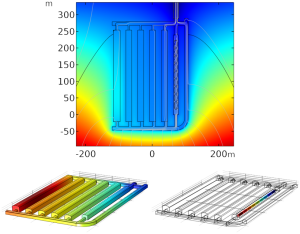
Kemakta, in collaboration with Niressa AB, has investigated the extent of this earth current-induced corrosion using numerical 3D modelling in Comsol Multiphysics. The modelling includes both detailed electrochemical corrosion kinetics on metal surfaces within the repository and the large-scale electric field formed in the repository spaces, tunnels, and surrounding rock. The modelling shows that emissions from the reactor tanks are dominated by general corrosion, with a limited contribution from earth current-induced corrosion, especially when the tanks are segmented prior to disposal.